FIRE isn’t about retiring at 40 to sit on a beach doing nothing.
For most people it’s about something quieter and more useful – reaching the point where work becomes a choice rather than an obligation.
In this post we’ll look at what the FIRE movement actually is, how it works, the number behind it, the different flavours of FIRE, whether it’s realistic here in Australia, and how to make a start from wherever you are.
I crossed $1,000,000 in net worth at the age of 38. I didn’t stop working, because I enjoy what I do. But somewhere along the way the pressure lifted, because the money no longer depended on me showing up. That shift – from having to, to choosing to – is really what this is all about.
What Is the FIRE Movement?
FIRE stands for Financial Independence, Retire Early.
It’s a movement built on a simple idea: if you save and invest a decent share of your income, you can reach a point where your investments cover your living costs, and paid work becomes optional. That point is financial independence. The “retire early” part is just what some people choose to do once they get there.
The heart of it is financial independence. Whether you actually retire, cut back to part-time, or keep working because you love it, is up to you. The goal isn’t to stop working. It’s to reach a position of choice.
How FIRE Actually Works
FIRE isn’t a trick or a special investment. It runs on one number more than any other – your savings rate, or as I prefer to call it, your pay yourself first money.
Your savings rate is the share of your take-home pay that you keep and invest, rather than spend. Someone saving 10% of their income and someone saving 40% are on completely different timelines, even on the same salary. The more of each pay packet you keep and put to work, the sooner your investments can carry you.
That surplus then does two jobs. It lowers the lifestyle you need to fund, and it becomes the fuel you invest. Both bring the finish line closer at the same time.
From there it’s the same engine behind all wealth – you invest that surplus across more than one asset class and let compounding do the heavy lifting over the years. If you want the full picture of how that part works, my guide on how to build wealth walks through it.
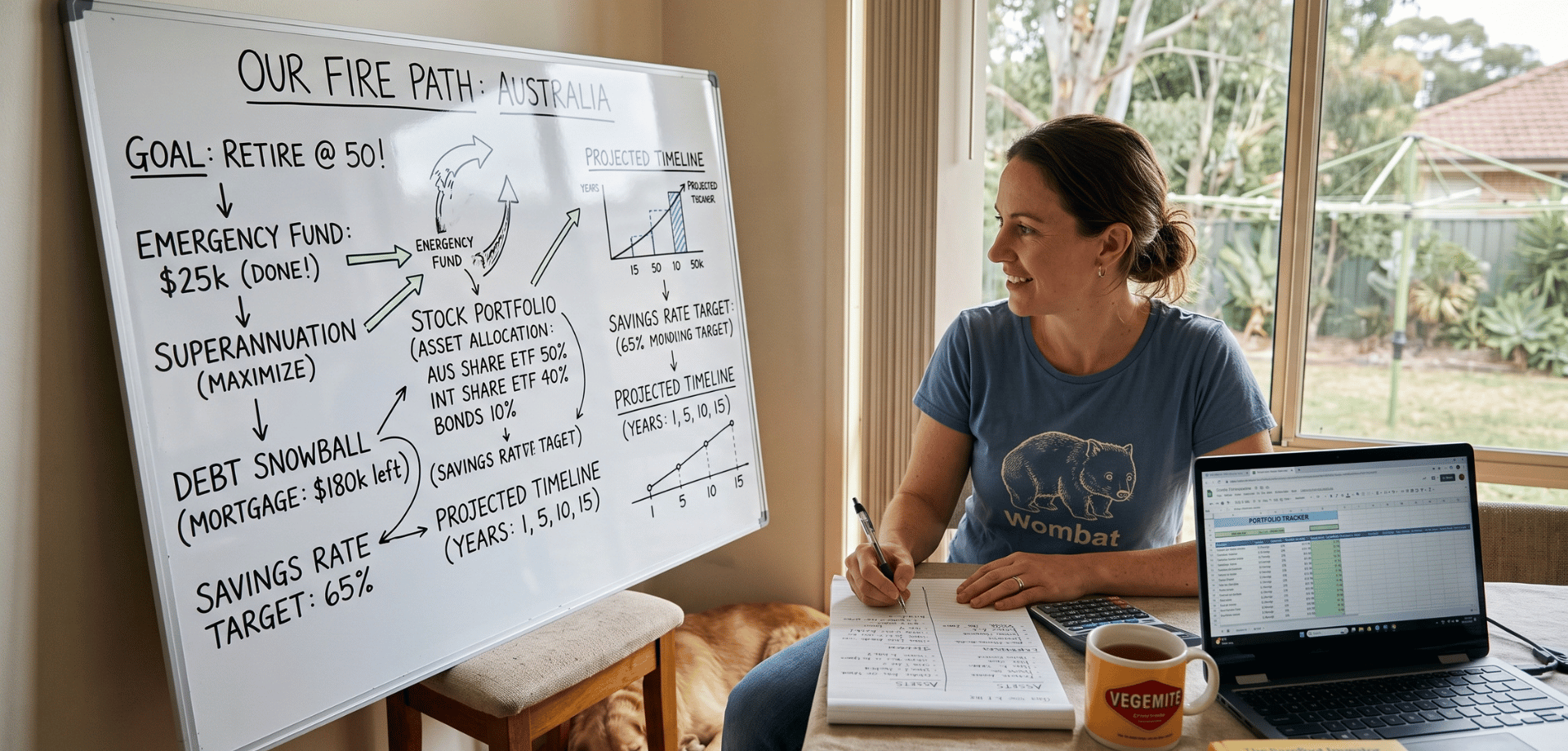
The Number Behind FIRE
So how much is “enough”? FIRE has a well-known rule of thumb for this, and it’s worth understanding even though it’s a guide rather than a promise.
It’s often called the 4% rule, or the 25x rule. The idea is that once your investments reach about 25 times your annual spending, you could withdraw around 4% of them each year to live on, and the balance would generally last over the long run.
Let’s put numbers on it. Say you need $60,000 a year to live the way you want.
25 times $60,000 is $1,500,000. And 4% of $1,500,000 is $60,000 – your yearly spending, covered.
That’s the target in plain terms – roughly 25 times your annual costs, invested. Notice what drives it, though. The number isn’t set by your income, it’s set by your spending. Someone who needs $40,000 a year reaches independence with a far smaller pot than someone who needs $100,000, on the same wage.
A word of caution, because this matters. The 4% rule is a useful starting point, not a guarantee. Real returns vary, markets fall as well as rise, inflation eats away at things, and everyone’s situation is different. Treat 25 times your spending as a target to aim at, and get proper advice before you rely on it. If you want to go deeper on working out how much you actually need, I’ve written a separate guide on just that.
The Different Flavours of FIRE
FIRE isn’t one strict path, and this is the part that lowers the bar for most people. There are gentler versions than the extreme “retire at 40” story you usually hear.
- Lean FIRE – Reaching independence on a modest, streamlined lifestyle. You need a smaller pot, because your yearly costs are lower.
- Fat FIRE – Independence with a comfortable, higher-spending lifestyle. It needs a bigger pot, but you give up less along the way.
- Coast FIRE – You invest enough early on that compounding alone should carry you to independence by traditional retirement age. From there you only need to cover today’s bills, not keep saving hard.
- Barista FIRE – You cover most of your costs from your investments and top up the rest with part-time or lower-stress work you actually enjoy.
Most people picture only the extreme version and decide it’s not for them. But Coast and Barista FIRE are far gentler, and for a lot of people they’re a more realistic and more enjoyable goal.
Is FIRE Realistic in Australia?
Yes, but our system has one feature worth understanding, and that’s superannuation.
In Australia, you generally can’t access your super until you reach your preservation age, which for most people is 60. That’s a big share of many people’s wealth locked away until then.
So retiring early here usually means building a second pool of investments outside super – shares, property, and the like – that can bridge the gap from the age you stop working until the age you can tap your super. Your super then takes over for the later years.
That’s not a reason it can’t be done. It just means an Australian path to early independence often has two stages, and it pays to plan for both. The rules around super and tax also change from time to time, so this is an area where getting advice for your own situation is genuinely worth it.
It’s also worth saying that most people are closer than they fear. Australians under 45 expect they’ll need around $100,000 a year in retirement, while many retired couples actually spend closer to $55,000. The gap you’re aiming to fill is often smaller than the one in your head.

How to Start Working Toward FIRE
You don’t need a huge salary or a perfect plan to begin. You need a few things working together, in order.
- Sort your money mindset – FIRE asks for patience and consistency, and both start in your head. A shift in your money mindset tends to come before the numbers move.
- Lift your savings rate – This is the single biggest lever. Getting clear on your numbers and learning to manage your money as a system is what frees up the surplus that makes any of this possible.
- Invest the surplus – Put that money to work across more than one asset class, and let time compound it. Some of that can be built into streams of passive income that keep paying with little day-to-day effort.
- Know your number – Work out roughly what 25 times your spending looks like, so you’ve got something concrete to aim at rather than a vague “more”.
- Get support if you want it – You don’t have to work it all out alone. That’s what financial coaching is for.
None of these need you to live on rice and cancel every bit of fun. They just need a decision to start, and the patience to keep going.
Common Misconceptions About FIRE
A few myths put people off before they begin. Let’s clear them up.
- “You have to be extremely frugal.” Not necessarily. A higher income or a Fat FIRE approach can get you there without extreme cutbacks. Frugality speeds it up, it isn’t the whole point.
- “You have to actually retire.” No. Financial independence is the goal. What you do with it – keep working, cut back, or stop – is your choice.
- “It’s only for high earners.” Income helps, but savings rate matters more. A modest earner who keeps a large share can outpace a high earner who spends it all.
- “It’s too late for me.” Coast FIRE and a later start still beat not starting. The point isn’t a perfect early finish, it’s more choice than you’d otherwise have.
In Summary
The FIRE movement is really about buying back choice – reaching the point where your investments cover your costs and work becomes optional.
It runs on your savings rate, aims at roughly 25 times your annual spending invested, and comes in gentler flavours than the extreme version most people picture. In Australia it usually means building wealth both outside and inside super, so you can bridge the years before you can access it.
You don’t need to retire at 40 or live like a monk. You just need to start lifting your savings rate and putting the surplus to work, this year.
What would financial independence actually give you – the freedom to change careers, to travel, or just to worry less?
P.S. Every FIRE journey starts with knowing your numbers, because your spending sets the target. Grab my free Wealth Tracker to see where your money goes – the surplus you find is the fuel for the whole thing.