

Most advice on how to save money makes you feel guilty about your morning coffee. This isn’t that.
Saving money isn’t about punishing yourself — it’s about widening the gap between what you earn and what you spend, so you’ve got something left over to build wealth with. Do that, and the coffee can stay.
This guide gives you a simple system, 25 practical tips built for Australia, a section for saving on a low income, and honest answers to the money “rules” you’ve seen online. Let’s put more of your money back in your pocket — on purpose.
General advice disclaimer: This article is general information only and doesn’t take your personal circumstances into account. It isn’t personal financial advice. For free, independent guidance, see ASIC’s Moneysmart.
How to save money: it’s really about “the gap”
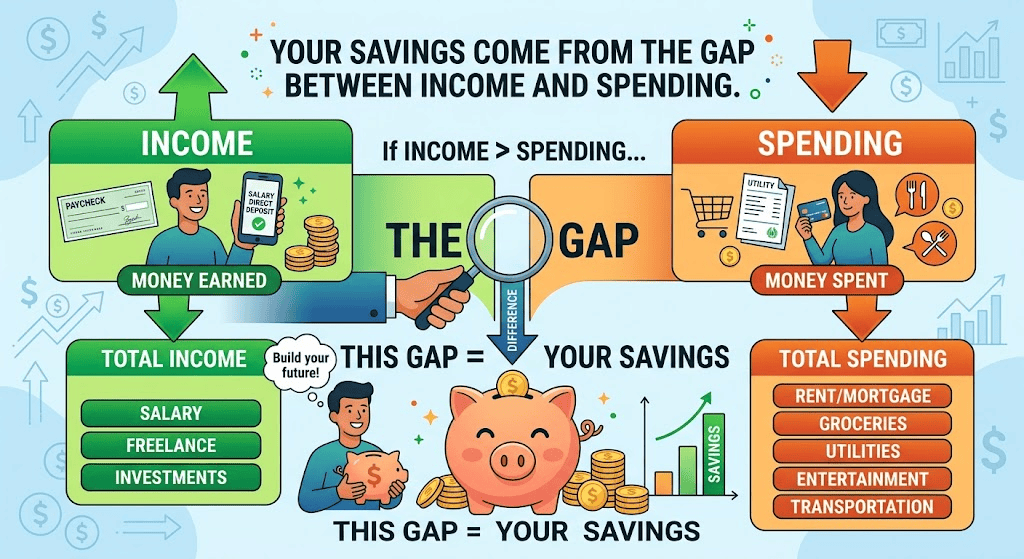
Here’s the idea that reframes everything: your wealth is built from the gap between what you earn and what you spend.
Income − spending = the gap. That gap is the fuel for everything — your emergency fund, your investments, your freedom. So there are only ever two levers: earn a bit more, or spend a bit less. This guide is about the second one — and the beauty is you control it starting today.
Knowing your starting point helps. Working out your “net worth” gives you a scorecard, and it’s genuinely motivating to watch the number move as your savings grow. You can get my Wealth Tracker to keep your own score.

The simple money-management system
Before we get to the tips, put a system in place — because the most reliable way to save money is good management, not willpower. Willpower runs out; a system doesn’t. I’ve writen a simple guide on how to manage your money to help get your started.
The core habit is pay yourself first. The moment you’re paid, move money to savings before you spend a cent. Don’t save what’s left after spending — spend what’s left after saving.
A simple four-account setup makes this automatic and is the foundation of managing money well:
- Income account — your income lands here; everything flows from this account.
- Goals account — a separate high-interest account for your emergency fund and goals. Automate a transfer here on payday.
- Everyday account — this is for your everyday living expenses and includes some money for fun stuff, so the plan is sustainable.
- Bills account – this is for all those items that you get a physical bill, your direct debits, and all those items that are part of living your life.
Set up automatic transfers so the money moves the day you’re paid, and you’ve solved 80% of how to manage money without thinking about it again.
25 ways to save money
Now for the tips. Here are 25 practical, Australian-specific ways to save money — grouped so you can pick the ones that fit your life. You don’t need all 25; even a handful adds up fast.
Bills and utilities
- Switch energy providers. Compare plans on the government’s Energy Made Easy site — many households save hundreds a year for ten minutes’ work.
- Review your phone and internet plans. You’re likely on an old, dearer plan than what’s available now.
- Haggle on your bills. Ring your providers and ask for a better rate or a loyalty discount — it works more often than you’d think.
- Review your insurance annually and switch. Loyalty rarely pays; re-quote your car, home and health cover each year.
Banking and fees
- Kill account-keeping and ATM fees. Move to a fee-free everyday account — there’s no reason to pay these.
- Never carry a credit card balance. Credit card interest is one of the fastest ways to go backwards. Clear it as a priority.
- Move savings to a high-interest account. Your savings should be earning the best available rate, not sitting idle.
- Find your lost super. Duplicate super accounts quietly charge duplicate fees — consolidate and check via the ATO.
Groceries and food
- Meal plan and shop to a list. The single biggest lever on a grocery bill.
- Buy home-brand and in bulk for staples — often identical products for less.
- Cut food waste. The average Australian household bins hundreds of dollars of food a year; use what you buy.
- Bring lunch and coffee from home a few days a week — not every day (sustainable beats extreme).
Subscriptions and lifestyle
- Audit your subscriptions. List every recurring charge; cancel what you don’t truly use.
- Share family/multi-user plans for streaming and apps.
- Buy second-hand for furniture, clothes and gear — Marketplace and op-shops are goldmines.
- Use the 30-day rule for non-essential wants (more on that below).
Transport and big-ticket wins
- Review your car costs. Insurance, fuel, servicing — and consider whether you need two cars.
- Buy used, not new, for cars — a new car loses value the moment you drive it out.
- Refinance or negotiate your mortgage. This is the biggest win of all — even a small rate cut on a home loan can save thousands a year.
- Reassess your rent or housing costs — your largest expense deserves the most attention.
Automate and stay on track
- Pay yourself first and automate the transfer on payday.
- Use round-ups — apps that round purchases to the nearest dollar and save the difference.
- Track your spending for one month so you can see where it actually goes.
- Set a specific savings goal with a number and date — it makes saying “no” to spending easier.
- Review the gap quarterly and nudge your automated savings up whenever you can.
Want a done-for-you starting point? Grab our free Playbook — the Post Budget Wealth-Building Playbook and set your money system up in one sitting.
How to save money on a low income
The principles for how to save money still apply on a tight budget — you just scale them to what you’ve got. It’s harder, but it’s also where a plan matters most. Don’t let “I can’t save much” become “I won’t save anything.”
- Start tiny and automatic. Even $5-$10 a payday builds the habit, and the habit is what counts.
- Claim what you’re entitled to. Check concessions, rebates and government support you may qualify for via Services Australia.
- Attack high-interest debt and avoid buy-now-pay-later. These quietly drain a tight budget faster than anything.
- Prioritise the big three — housing, transport, energy. Small wins there beat cutting every small pleasure.
- Use free and low-cost alternatives — libraries, community programs, second-hand, and no-spend days.
Progress on a low income is still progress. Widen the gap by whatever you can, and let it compound over time.
Popular money-saving “rules” explained
You’ve probably seen these online. They’re really just shortcuts for how to save money consistently — here’s what each actually means.
- The 30-day rule: before buying something non-essential, wait 30 days. If you still want it after a month, buy it. Most of the time the urge passes — and you keep the money.
- The $27.40 rule: saving $27.40 a day adds up to $10,000 in a year ($27.40 × 365). It reframes a big goal into a daily habit.
- The $1-a-day idea: $1 a day is $365 a year — proof that small, consistent amounts genuinely add up, especially once invested.
- The 50/30/20 guide: roughly 50% of after-tax income to needs, 30% to wants, 20% to saving and debt — a simple starting split you adjust to your life.
Rules like these work because they turn a vague intention into a concrete, repeatable action.
How to grow the money you save
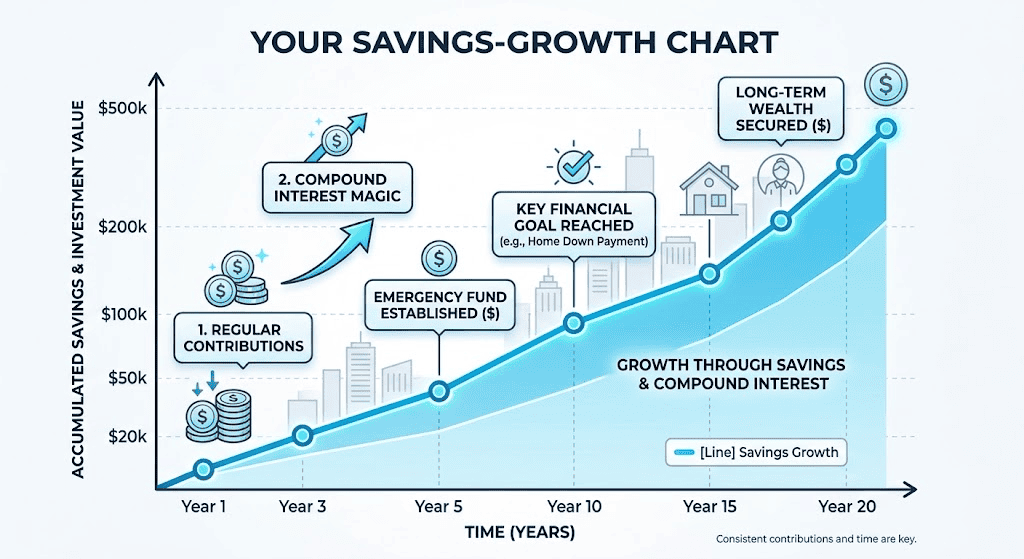
Saving is step one — but money sitting in a bank account slowly loses value to inflation. To actually build wealth, put your savings to work in the right order:
- Emergency fund first — 3-6 months of expenses in a high-interest savings account.
- Then invest the rest. Once your buffer is set, your surplus can go to work. See our beginner’s guide on “how to invest“, and how “compound interest” turns modest savings into real wealth over time.
This is how learning to save money becomes wealth-building — and it’s the whole point of widening the gap in the first place. If you’d like a full plan tying your saving, investing and goals together, start with our “step-by-step guide to financial planning” and also our learn the fundamentals outline.
Your next step
Knowing how to save money isn’t about deprivation — it’s about being intentional so your money goes where you want it to. Put the four-account system in place, pick a handful of the 25 tips, automate the gap, and then invest what you save. That’s really all how to save money comes down to — do it consistently and you’ll be surprised how quickly it adds up.
If you know you should be saving and investing but keep putting it off, that’s exactly what coaching is for.
Ready to take control of your money? Schedule a Smart Investor Call and let’s build your plan together. Or learn more about wealth coaching.

The 30-day rule means waiting 30 days before buying anything non-essential. If you still want it after a month, buy it — but most impulse urges fade, so you keep the money instead. It’s a simple way to curb impulse spending without banning treats altogether.
Break it into a daily target — saving about $27.40 a day reaches $10,000 in a year. Speed it up by attacking your biggest expenses first (mortgage or rent, insurance, energy), automating transfers on payday, and redirecting any windfalls or pay rises straight to savings.
It’s a simple reframe: saving $27.40 every day adds up to $10,000 over a year ($27.40 × 365 ≈ $10,000). Turning a big, daunting goal into a small daily habit makes it feel achievable.
Switch energy providers, review your phone and internet plans, cancel unused subscriptions, move savings to a high-interest account, avoid credit card interest, meal plan and shop to a list, buy home-brand, review your insurance yearly, refinance your mortgage, and automate your savings on payday.
Start with tiny automatic transfers (even $5 a payday), claim any concessions and rebates you’re entitled to, avoid high-interest debt and buy-now-pay-later, and focus your effort on your biggest costs — housing, transport and energy — rather than every small treat.