

For a lot of people, investing feels tricky — so tricky that many never start at all. They hit a couple of confusing steps, freak out, and give up.
Let me put your mind at ease: investing is simpler than it looks. These steps can be complicated if you let them, but they don’t have to be. The key is to understand what you’re trying to achieve, then apply your goals to a few clear steps — the smart way.
This guide walks you through exactly that: what you can invest in, how to start, and how to invest your first $1,000 — with an Australian lens the whole way. No jargon you don’t need, no hype.
General advice disclaimer: This article is general information only and doesn’t take your personal circumstances into account. It isn’t personal financial advice. Investing carries risk, including the risk of losing money. Before acting, consider whether it’s right for you and, if needed, speak with a licensed financial adviser. For free, independent guidance, see ASIC’s Moneysmart.
What does it mean to invest?
Investing means putting your money into assets — like shares, ETFs, property, commodities or bonds — so it can grow and produce income over time, rather than sitting in cash losing value to inflation. Saving is setting money aside; investing is putting that money to work.
Here’s the mindset that changes everything: at The Investors Way we invest for cash flow first, growth second. Your first objective is to build enough income from your investments to cover your living expenses — what we call your freedom number. Growth is the bonus that gets you there faster.

Before you invest — get your foundations right
Investing works best on a solid base. Before you put a dollar into the market, cover three things:
- An emergency fund — a starter buffer of around $2,000, then work toward 3-6 months of expenses. This stops you having to sell investments at the worst time.
- High-interest debt — clear credit cards and personal loans first. Paying off an 18% credit card is a guaranteed 18% return, better than most investments.
- A clear goal and timeframe — what you’re investing for, and when you’ll need the money. If it’s a solid plan you’re after first, start with our “step-by-step guide to financial planning“.
It also helps to know your starting point — working out your “net worth” gives you a clear scorecard to measure your progress against. Get these sorted and you can invest with confidence instead of anxiety.
How investing builds wealth (the power of time)
The real engine of investing isn’t picking winners — it’s time. When your returns earn their own returns, your money snowballs. That’s compounding, and it’s why starting early with small amounts beats waiting until you have “enough.”
Even $50 a week, invested consistently, grows into a serious sum over the years. See exactly how in our guide to “the power of compound interest“. The takeaway: the best time to start was years ago; the second best time is today. Investing is also how you build passive income over time.
What can you invest in?
When you’re learning how to invest, the world of investing can feel like it has thousands of options — but three main assets form the backbone of a smart strategy, plus super, which most Australians are already invested in without realising. Each has its own pros, cons and tax quirks.
Shares (the ASX)
When you buy a share, you become a part-owner of a company and are entitled to a slice of its profits — paid to you as dividends, which is where the cash flow comes from (a genuine form of “passive income“. Invest the smart way and you’re looking for quality companies making consistent profits and paying reliable dividends. In Australia, many dividends also come with franking credits, a tax benefit worth understanding (your accountant or the ATO can explain how they apply to you).
Exchange Traded Funds (ETFs)
Most people say the same two things: “I don’t have time to research individual stocks,” and “I wouldn’t know what to look for anyway.” That’s exactly what ETFs solve. An ETF bundles many shares into one investment that tracks a whole market — for example, an ETF that follows the ASX 200 gives you a slice of Australia’s 200 biggest companies in a single trade. As the market grows over time you benefit, and you still collect dividends. Simple, low-cost, and diversified from day one. (There are international ETFs too, if you want exposure beyond Australia, and a good way to start investing more broadly.)

Property
Property is a big enough topic to be a guide in its own right — too much to cover fully here. But here’s the one principle most people get backwards: since our aim is cash flow, you want positively geared property — where the rent you receive is more than your costs (mortgage interest, running costs, maintenance). And if choosing and managing a property isn’t for you, there are property shares and ETFs (REITs) that give you exposure to the property market without owning a single door.
Bonds and fixed interest
For stability, it’s wise to have some money earning a fixed rate of return — government or corporate bonds, or even a simple term deposit. Another fixed-income style option worth knowing about is “peer-to-peer lending“, where you earn interest by lending to borrowers. It’s secure, steady cash flow that balances the ups and downs of shares and adds to your freedom number.
Superannuation
Don’t forget super — it’s an investment account you already have, and it’s tax-effective for your long-term/retirement goals. Making the most of it is one of the highest-return moves most Australians can make; more in our “retirement planning guide“.
How do you want to own your investments?
Before you start splashing money into assets, there’s one decision that has a big impact on your tax and your risk: how you own your investments. Your first reaction is probably “well, I’ll own them” — fair enough, but this choice has real tax implications.
Investments can be held in different names or structures:
- Your own name
- Joint names — with a spouse or family member
- A trust — such as a family trust or unit trust
- A company
- Your superannuation (including an SMSF)
Each has different tax treatment, so it’s a decision worth making early to protect your profits. This is the one area where I genuinely recommend getting advice — from a good accountant who understands what you’re trying to achieve (your accountant, not someone pretending to be your financial adviser). Many years ago when I made this decision, I came away from my accountant with three options: some investments in a family trust, some in my super, and a small number in my own name.
Don’t let this step stop you, though. Understand the options, get advice on the right one for you, and move on with confidence.
How to invest: 6 steps to get started
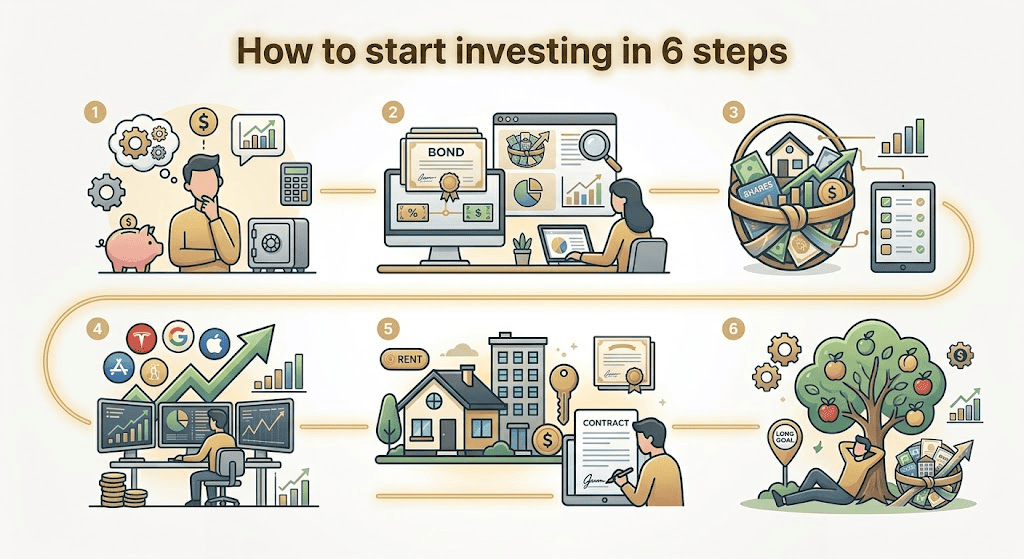
Once you know what to invest in, here’s how to invest in practice — the simple process to go from “thinking about it” to actually invested.
- Set your goal and timeframe. Know what the money is for and when you’ll need it. Short-term goals stay in cash; long-term goals can be invested.
- Choose your ownership structure. Sort out whose name/structure you’ll invest in (see above) — a quick chat with your accountant.
- Open an account. For shares and ETFs, open a share-trading account or brokerage (many Australians start with a low-cost online broker or a micro-investing app). For super, check and consolidate your funds.
- Choose your investments. Start simple — a low-cost, diversified ETF or two is a common starting point. Match your choices to your goal and timeframe.
- Automate it. Invest a set amount every payday. Consistency beats willpower, and it removes the temptation to “time the market.”
- Review, don’t tinker. Check in every 6-12 months against your goals — but resist the urge to chop and change. Time in the market beats timing the market.
How to invest your first $1,000
You do not need thousands to begin — you can start with $100 or less through micro-investing and low-cost ETFs. If you’ve got your foundations covered, a simple beginner path looks like this:
- Put it into one broad, low-cost ETF (for example, one that tracks the ASX 200 or a diversified index) so you’re instantly spread across hundreds of companies.
- Set up an automatic contribution — say $50-$100 each payday — into the same investment.
- Leave it alone and let compounding do the work, adding more whenever you can.
That’s genuinely it. The best way to invest money as a beginner isn’t clever — it’s simple, low-cost, automated, and consistent.
The long-term investing mindset
Here’s the secret the professionals won’t dress up: you don’t have to pick the perfect time to buy. Since you’re in this for the long haul, the best time to invest is right now — and then again next month, and the month after that.
Buying a fixed amount at regular intervals is called dollar-cost averaging. It smooths out the highs and lows, takes the emotion out, and means you never have to guess the market’s next move. Ignore the noise, stay diversified across the asset types above, and keep going. That consistency is what builds wealth.
Common beginner mistakes to avoid
- Waiting until you “know enough.” You learn by starting small, not by reading forever.
- Trying to time the market. Even the experts can’t do it reliably. Automate instead.
- Putting everything in one thing. Diversify across assets to spread your risk.
- Paying high fees. Fees compound against you — favour low-cost options.
- Chasing hype. If it promises to turn $1,000 into $10,000 fast, it’s speculation (or a scam), not investing.
- Letting the tax/structure step stop you. Get advice, decide, and move on.
Your next step
Investing really is simple when you strip away the noise: get your foundations right, decide how you’ll own your investments, spread your money across quality assets for cash flow first and growth second, then automate it and keep going — month after month after month — toward your freedom number.
If you know you should be investing but keep putting it off, or you want help building a plan that actually fits your goals, that’s exactly what coaching is for.
Ready to start investing the smart way? Schedule a Smart Investor Call and let’s map out your plan together. Or learn more about wealth coaching.

Get your foundations right first (emergency fund, clear high-interest debt, a clear goal), then open a low-cost share-trading account or micro-investing app, choose a simple diversified ETF, and set up an automatic contribution each payday. Start small, stay consistent, and review every 6-12 months.
Most beginners start with a low-cost, diversified ETF — for example one that tracks the ASX 200 — because it spreads your money across hundreds of companies in a single, simple investment. As you learn, you can add other assets like international ETFs, property exposure or bonds to suit your goals.
Not much. Thanks to micro-investing apps and low-cost ETFs, you can start with $100 or even less in Australia. What matters far more than your starting amount is investing regularly and consistently over time.
Yes. $100 is enough to buy into many ETFs or micro-investing options. The habit is the point — $100 invested every payday, left to compound, grows into a meaningful sum over the years.
For most people, the first priorities are making the most of superannuation (tax-effective and long-term) and a low-cost, diversified ETF for money outside super. Match where you invest to your goal and timeframe, and get tax advice on how you own the investments.
Heh Damo
The simplest way to invest in Bonds is using ETFs, there is one in Australia with the code: BOND. That’s not a recommendation, but take a look to get an idea of what it does. To access the Bond market directly requires larger sums of money so this is a simple way to go about it.
How does one invest in Bonds? Is that through a brokerage platform like commsec, just like buying shares or ETFS?