
This Tuesday, the Reserve Bank meets to decide where interest rates go next – and once again, a rise is the bet most are making.
Before the headlines send your blood pressure up, let’s take a calm look at what’s actually going on, why it’s happening, and what it does and doesn’t mean for your money.
In this post we’ll look at where rates are right now, what’s driving them, why the burden of fixing it falls so unevenly, what a rate rise means for everyday Australians, and the one thing that matters far more than any single decision.
Where Things Stand Right Now
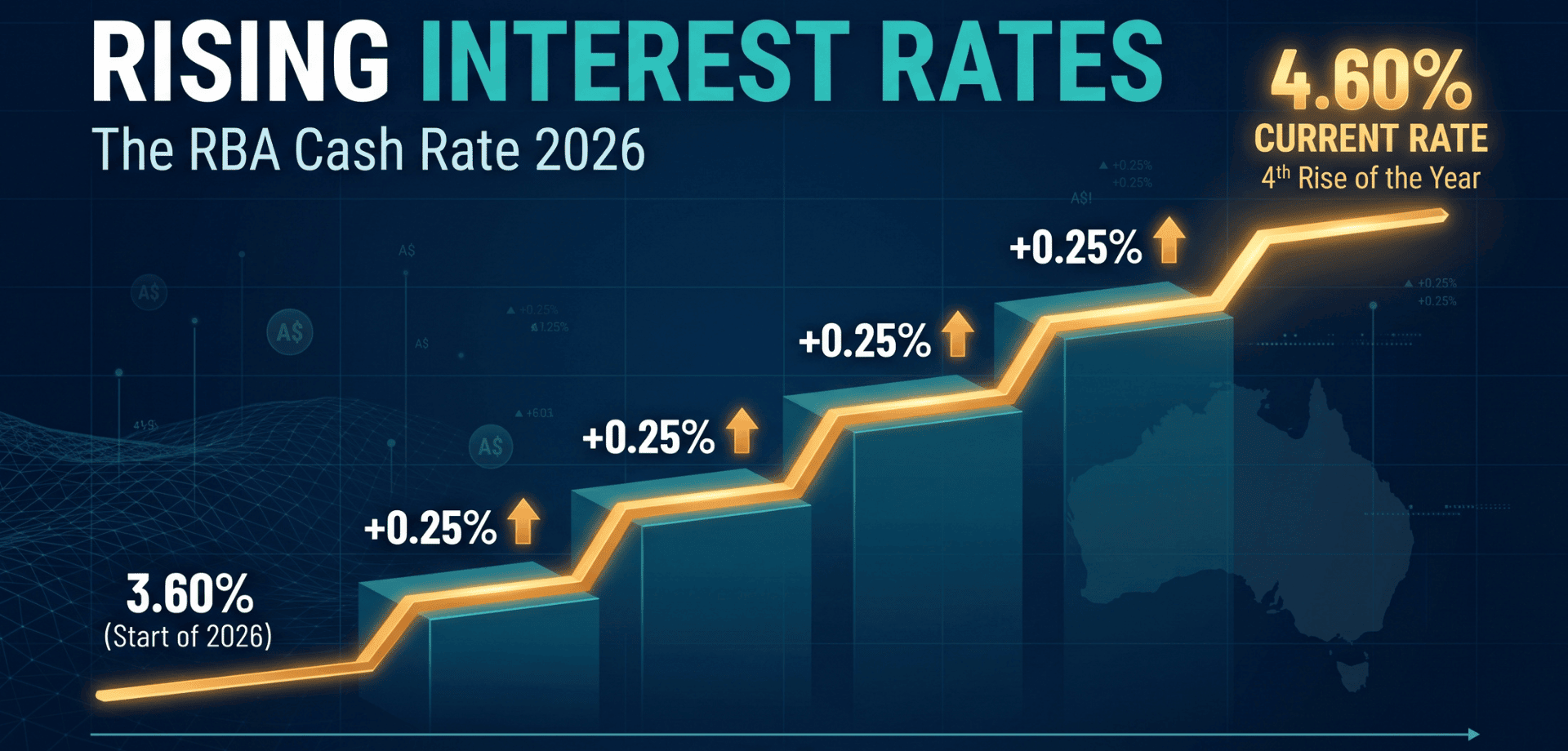
The official cash rate – the interest rate the Reserve Bank sets, which flows through to your mortgage and savings – currently sits at 4.60%.
That’s after a rise in September, the fourth increase this year, adding up to a full one percent over 2026. Going into Tuesday’s meeting, markets are pricing in roughly a 70% chance of another rise, though the Bank could still choose to hold. Nobody knows for certain, and anyone who tells you they do is guessing.
So this isn’t a one-off. After a stretch of steady and falling rates, 2026 has quietly become the year rates started climbing again.
Why Are Rates Rising?
The short version: inflation has come back, and lifting rates is the main tool the Reserve Bank has to cool it down.
When prices rise too quickly, the Bank raises interest rates to take some heat out of spending. Higher rates mean higher repayments and less spare cash, which slows demand, which eventually eases prices. It’s a blunt tool, but it’s the one they’ve got.
What’s pushing prices up this time is largely coming from outside our borders. The Reserve Bank has pointed to disruptions to global oil and energy supply, tied to the widening conflict in the Middle East, as well as rapid price growth in technology goods driven by the huge demand around artificial intelligence. Those global costs flow through to what businesses here charge.
It’s not just us, either. Central banks overseas, including the US Federal Reserve, have been lifting rates for similar reasons. This is a global story playing out in your local grocery bill.
There’s a closer to home factor too, and it’s the one lighting up social media right now. Many economists and commentators argue that government spending is adding fuel to the fire. When the Government keeps spending freely, it pumps more demand into the economy, which pushes prices up and makes the Reserve Bank’s job of cooling things down that much harder. In plain terms, one hand of the system is hitting the brakes while the other keeps pressing the accelerator.

The Uncomfortable Part
Here’s what makes this moment unusual, and worth understanding.
Normally rates rise when the economy is running hot. This time, they’re rising even as growth slows, consumer spending eases, and house prices fall across most capital cities.
That’s an awkward mix – the cost of living and borrowing going up while the broader economy softens. It’s why there’s so much debate about Tuesday’s decision, and why it feels more unsettling than a typical rate move.
If it feels confusing, that’s because it genuinely is a tricky set of conditions, even for the experts.
Who Actually Pays for This?
Here’s the part that’s got a lot of people fired up, and it’s a fair question.
When the Reserve Bank raises rates to fight inflation, who actually feels it? Mortgage holders. And only around a third of Australian households even have a mortgage.
So a problem that everyone had a hand in – through global prices, through spending right across the economy, through government decisions that affect all of us – gets handed to a minority to solve. Roughly one in three households is left carrying the cost of cooling inflation for the whole country, through higher repayments, while the other two thirds feel far less of the direct pinch.
If you’re one of those mortgage holders, it’s completely reasonable to feel like you’re being asked to carry more than your share. Because you are.
None of this is to paint the Reserve Bank as the villain. Raising rates is close to the only tool it has, and it’s a blunt one. But it’s worth naming the unfairness honestly, rather than pretending the load is shared evenly when it plainly isn’t.
What a Rate Rise Actually Means for You
Strip away the drama and a rate rise touches most people in three practical ways.
- If you have a mortgage – Your repayments go up, or more of each repayment goes to interest. On a big loan, even a small rise adds up, so it’s worth knowing your numbers rather than being caught by surprise.
- If you’re a saver – It’s not all bad news. Higher rates usually mean better returns on savings accounts and term deposits, so the cash you hold can work a little harder.
- If you’re an investor – Markets often wobble around rate decisions, because borrowing costs rise and nervous investors react. Those swings can be unsettling, but they’re a normal part of the picture, not a signal to panic.
The point isn’t to tell you what to do – I’m a coach and educator, not a licensed adviser, and this is general information rather than personal advice. The point is to help you see it clearly, so you can make calm decisions instead of fearful ones.
The Thing That Matters More Than Tuesday
Here’s the reframe I’d gently offer.
You can’t control the Reserve Bank, the price of oil, a conflict on the other side of the world, or a Government that won’t rein in its spending. Spending your energy worrying about them is exhausting and pointless.
What you can control is your own position. You can take control of your cash flow so higher repayments don’t blindside you. You can keep your plan steady instead of reacting to every headline. And you can keep investing through the cycle, letting compounding do its quiet work, rather than jumping in and out based on fear.
Because here’s the long view. Interest rates have risen and fallen many times over the decades, and they’ll keep doing it long after this cycle is forgotten. The investors who build real wealth aren’t the ones who perfectly predict each move. They’re the ones who stayed calm, stuck to good habits, and kept going while others panicked. That’s where your money mindset earns its keep.
If you do want to put spare money to work in a higher-rate environment, I’ve written separately about what to do with your money when rates rise, and more broadly about how to invest with a plan.
In Summary
Rates are at 4.60%, another rise is on the cards this Tuesday, and it’s being driven largely by global forces – energy prices and the AI-fuelled demand pushing up costs around the world – even as our own economy softens.
For you, it mostly comes down to mortgages costing more, savings earning a bit more, and markets being jumpy. None of which changes the fundamentals of building wealth: control what you can, ignore the noise you can’t, and keep going.
Rate decisions come and go. A good plan, calmly followed, is what carries you through all of them.
How are you feeling heading into this one – worried, unbothered, or somewhere in between? Email me your thoughts.
P.S. When the environment shifts like this, the people who stay calm are the ones with a clear plan already in place. My free Playbook walks you through investing with a plan, whatever the market is doing – grab it now.